
Filing a roof insurance claim in Louisiana after a storm is not complicated, but it has a specific sequence that matters. Do things out of order and you can slow down the payout, reduce what you collect, or give an adjuster grounds to attribute damage to maintenance issues instead of the storm. Do things in the right order and the process is straightforward, even if it takes a few weeks to complete.
This guide walks through the full process from the hour after the storm to the final repair payment, with attention to the parts that are specific to Louisiana, including named storm deductibles, the current assignment of benefits rules, and what to look for in contractor paperwork.
Before You Touch Anything: Document the Damage
The single most important thing you can do in the first 24 hours after a storm is document your roof and home before any cleanup happens.
Pull out your phone and take photos and video of every part of the roof you can see from the ground. Walk the full perimeter. Photograph the yard, any debris on or around the house, the gutters, the soffit edges, and the driveway. If you have a drone or can borrow one, aerial images of the roof surface are extremely useful. If not, document as much as possible from multiple angles.
Inside the house, go room by room and look at ceilings and walls for any new water stains. Check the attic if it is safe to access. Water stains on rafters, wet insulation, or daylight coming through the decking are all important to capture. Document those too.
Name your files with the date. Something like 2025-09-14 ridge east water stain is more useful than IMG_4831 when an adjuster or public adjuster is sorting through your documentation weeks later.
What you are building here is a baseline record that shows the damage existed immediately after the storm and was not there before it. This matters because insurance adjusters are trained to look for signs that damage predates the weather event. A clear time-stamped photo record taken within hours of the storm makes that argument much harder to make.
Do not make any permanent repairs before the adjuster sees the roof. You can and should do emergency tarping or temporary dry-in work to prevent further water intrusion. That is expected and most policies allow it. But do not replace shingles or repair flashing before the insurance company has sent someone out. If you do, you may lose documentation of the original damage scope.
Save any debris you can store safely. Loose shingles, broken ridge caps, or torn flashing pieces can be useful reference points during the inspection.
Call Your Insurance Company, Not a Contractor First
Once you have your documentation, call your insurance carrier to open the claim. This comes before you call a roofing contractor for repairs.
The reason this order matters: once a claim is open, you are operating under your policy’s terms and your insurer’s procedures. Starting repairs before a claim is open can create confusion about what was pre-storm condition versus storm damage. Some policies also have language that requires prompt reporting of damage. Getting the claim open within a day or two of the storm keeps you in compliance with that requirement.
When you call, have the following ready:
Your policy number. Have it written down somewhere accessible because phone systems and busy claim lines after a named storm are not the time to be searching through email.
The date and name of the storm event. If it was a named storm or hurricane, use the official name from the National Hurricane Center. This matters for how your deductible is calculated.
A brief description of what you observed. You do not need to estimate costs or describe the full scope. Just report that you have visible roof damage and document the date you noticed it.
The insurer will give you a claim number. Write it down immediately. This number is what you reference for every future call, email, or document.
Understand Your Deductible Before the Adjuster Arrives
Louisiana homeowner policies have two types of deductibles that apply to storm damage, and they work very differently. Knowing which one applies to your claim before the adjuster arrives saves confusion later.
Standard deductible: This is a flat dollar amount, often $1,000 or $2,500, that applies to most claims. If your repair estimate comes in at $12,000 and your standard deductible is $2,500, the insurer pays $9,500.
Named storm or hurricane deductible: This is a percentage of your home’s insured value, not a flat amount. Louisiana law defines a named storm as any system declared by the National Hurricane Center. Under Louisiana RS 22:1337, this deductible applies on an annual basis, meaning if you pay it once in a calendar year, subsequent named storm claims in the same year are not subject to it again.
The percentage varies by policy but is commonly 2 to 5 percent. On a home insured for $300,000, a 2 percent named storm deductible is $6,000 out of pocket before insurance pays anything. On a home insured for $400,000 with a 5 percent deductible, that is $20,000.
This surprises a lot of Northshore homeowners who hear a neighbor got a full roof replacement covered after Ida or Laura and assume their own claim will work the same way. It may, or it may not, depending on the scope of damage relative to your deductible amount.
Before the adjuster comes out, do this math yourself. Look at your declarations page for the insured value of your dwelling (not the market value, the insured value), find the named storm deductible percentage, and calculate the number. That is the minimum repair scope you need for the claim to result in any insurance payout at all. If the damage is close to that number, a detailed inspection report from a contractor can help establish the full scope before the adjuster visit.
Know Whether Your Policy Pays Replacement Cost or Actual Cash Value
This is the second piece of your policy you need to understand before the adjuster arrives.
Replacement cost value (RCV): Pays what it costs to replace your roof with a comparable new roof at current material and labor prices. This is the coverage most homeowners want.
Actual cash value (ACV): Pays the replacement cost minus depreciation. A 15-year-old shingle roof on a 20-year lifespan has used up most of its life expectancy in the insurer’s calculation. You might receive a check for 25 percent of what a new roof actually costs.
Some policies start as ACV and release the depreciation holdback after the repairs are completed and documented. Others are strictly ACV with no path to recovering depreciation. Read your policy or call your agent to confirm which you have before you assume.
If you have ACV coverage and the depreciation holdback is significant, it may still be worth proceeding with the claim, but you need to go in knowing the numbers.
What Happens During the Adjuster Inspection
After you open the claim, the insurance company will schedule an adjuster to inspect the roof. Depending on the volume of claims after a major storm, this can take anywhere from a few days to several weeks.
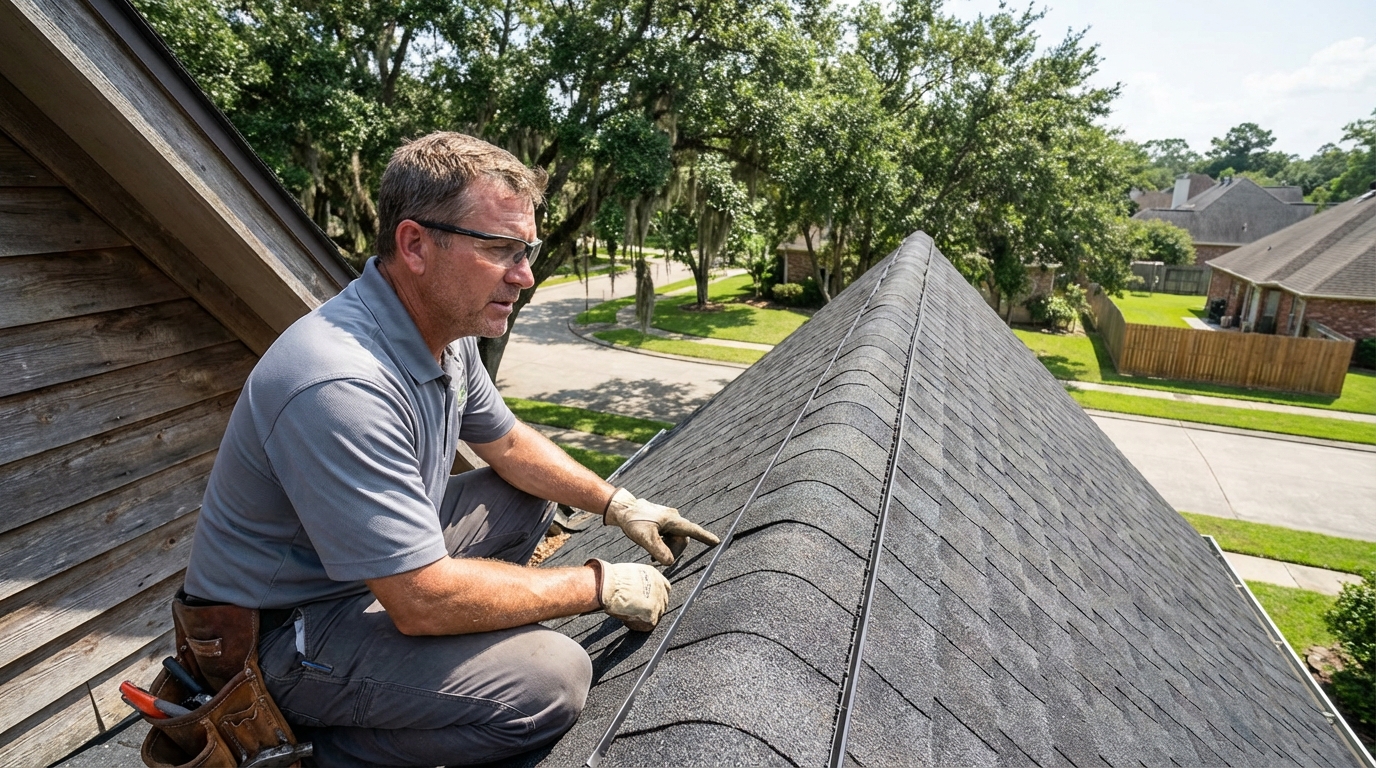
You have the right to have a roofing contractor present during this inspection. This is worth doing. An adjuster works for the insurance company. A contractor present at the inspection can point out damage items that an adjuster might miss or assess differently, including flashing damage, drip edge issues, satellite penetrations, and damage to gutters or soffit that is connected to the same storm event.
If you already have a scope estimate from a contractor before the adjuster visit, bring it and share it. This creates a written record of what was identified before the insurance company’s evaluation.
During the inspection, walk with the adjuster if you can and ask questions about anything they note or skip. You are allowed to ask what they are documenting, what they are excluding, and what the basis is for any exclusion. Write down what they say.
After the inspection, you will receive an adjuster’s report and an initial estimate. This is not the final number. You can dispute it if your contractor’s scope is materially different.
Getting a Contractor Estimate and What to Look for in the Paperwork
Once the claim is open and you have the initial adjuster report, get a written scope and estimate from a licensed Louisiana roofing contractor. Under Act 422, residential roofing contractors in Louisiana are required to be licensed through the LSLBC as of January 1, 2026. Verify the license before anyone does work on your roof.
The contractor’s estimate should itemize materials, labor, disposal, and any code-required upgrades. In Louisiana, Act 239 requires permits for all roofing work performed after August 1, 2025. A legitimate contractor will pull a permit. The permit creates a documented record of the work, which protects you for insurance purposes and future sales.
What to watch out for in contractor paperwork after a storm:
Louisiana prohibits post-loss assignment of benefits agreements for most residential property claims. An assignment of benefits document transfers your insurance claim rights to the contractor, meaning they deal directly with the insurer and you lose control of the process. Some forms that come with storm-chasing crews use language that functions as an AOB without labeling it that way. Read any paperwork before signing, and if a clause says anything about transferring, assigning, or conveying your insurance benefits, claim proceeds, or right of action, do not sign it without talking to your insurance agent or an attorney first.
A legitimate contractor does not need your claim rights. They need your authorization to do the work and an agreement on the scope and price. Those are two separate documents from an AOB.
Also watch for contracts that ask you to pay your deductible to them in advance, then promise to “work with insurance” to cover the rest. This is a common structure used by out-of-state crews after large storms in the Northshore area. A reputable local contractor provides an estimate, you pay the deductible, the insurance pays the covered portion, and the contractor invoices for the total.
If the Adjuster’s Estimate Is Too Low
It happens regularly after storms in Louisiana. The adjuster’s initial estimate comes in below what a legitimate contractor says the repair actually costs.
You have options.
First, provide a line-by-line comparison of the adjuster’s scope and your contractor’s scope. Note specifically where they differ and why. Common discrepancies include underpriced labor, missing line items for code-required upgrades like drip edge replacement, and failure to include damaged gutters, soffit, or flashing in the storm damage scope.
Submit this comparison in writing to your adjuster and request a supplemental review. Most carriers have a reinspection or supplement process. If your contractor has photos documenting each item in dispute, that documentation should accompany the request.
If the insurer continues to offer less than what the repair actually costs, you have the right to invoke the appraisal process that is written into most Louisiana homeowner policies. This process brings in an independent appraiser on each side and a neutral umpire to determine the loss amount. It is not litigation, but it is a formal dispute process that often produces a higher settlement than the initial offer.
If you believe the claim is being handled in bad faith, the Louisiana Department of Insurance handles complaints against carriers. A documented claim file gives you the foundation to pursue that if it becomes necessary.
After the Claim Is Approved: Mortgage Company Involvement
If you have a mortgage, your insurance check will likely be made out to both you and your lender. This catches homeowners off guard after a storm because it means you cannot simply cash the check and pay a contractor. The mortgage company has to endorse it first.
Most lenders have a loss draft department that handles this process. Call your mortgage servicer as soon as you receive the insurance check and ask about their procedures. They will typically require a signed contractor agreement, a copy of the adjuster report, and sometimes proof that the contractor is licensed and insured before they release funds.
Some lenders hold the full amount and release it in draws as work is completed. Others release a portion upfront and the remainder after completion documentation is submitted. Ask your servicer how they handle it so you and your contractor can plan the payment schedule accordingly.
Should You Consider FORTIFIED When the Roof Is Being Replaced?
If your roof is being replaced as a result of storm damage, this is the moment to ask whether upgrading to FORTIFIED standards makes sense.
A FORTIFIED Roof installation meets the building standards developed by the Insurance Institute for Business and Home Safety (IBHS) for wind resistance. It addresses the three most common failure points in hurricane events: roof deck attachment to the framing structure, sealing the roof deck so water does not enter if shingles are lost, and reinforcing the roof edge against uplift.
In Louisiana, a FORTIFIED Roof designation qualifies homeowners for insurance discounts that can be substantial, particularly in the St. Tammany Parish market where insurance rates have climbed significantly. Starting July 1, 2025, Louisiana also offers a state income tax credit of up to $10,000 for qualifying FORTIFIED Roof installations under HB 145.
Adding FORTIFIED specifications to a replacement that is already being paid through an insurance claim typically adds a smaller incremental cost compared to doing it as a standalone project. The insurance discount and the tax credit can offset a meaningful portion of that difference over two to three years.
Ask any contractor you hire whether they are IBHS-certified for FORTIFIED Roof installations. Not all Louisiana roofers are certified to complete this work and have the installation verified.
The Full Claim Process at a Glance
Here is the complete sequence in order:
Document all damage with time-stamped photos and video before any cleanup
Call your insurance carrier to open a claim and get a claim number
Calculate your deductible and confirm whether your policy pays replacement cost or actual cash value
Schedule the adjuster inspection and request a licensed roofing contractor be present
Obtain a written scope and estimate from an LSLBC-licensed roofing contractor
Compare the contractor’s estimate to the adjuster’s report and submit supplements if there are discrepancies
Review all contractor paperwork carefully before signing, specifically any language about claim rights or benefits transfer
Notify your mortgage servicer once the claim is approved and coordinate the endorsement process
Consider whether a FORTIFIED upgrade makes sense if a full replacement is part of the scope
Confirm the contractor pulls a permit before work begins, as required by Act 239
A Note on Timing
Louisiana law requires carriers to acknowledge receipt of a claim within 14 days and to accept or deny it within 30 days of receiving all required documentation. If you have submitted everything and the carrier is not moving within those timelines, document the dates and contact the Louisiana Department of Insurance.
After a named storm that affects a large portion of the state, these timelines can feel slower in practice even when technically met, because claim volume is high. Getting your documentation together quickly and completely is the fastest way to move through the backlog.